


Temple I (Temple of the Giant Jaguar)
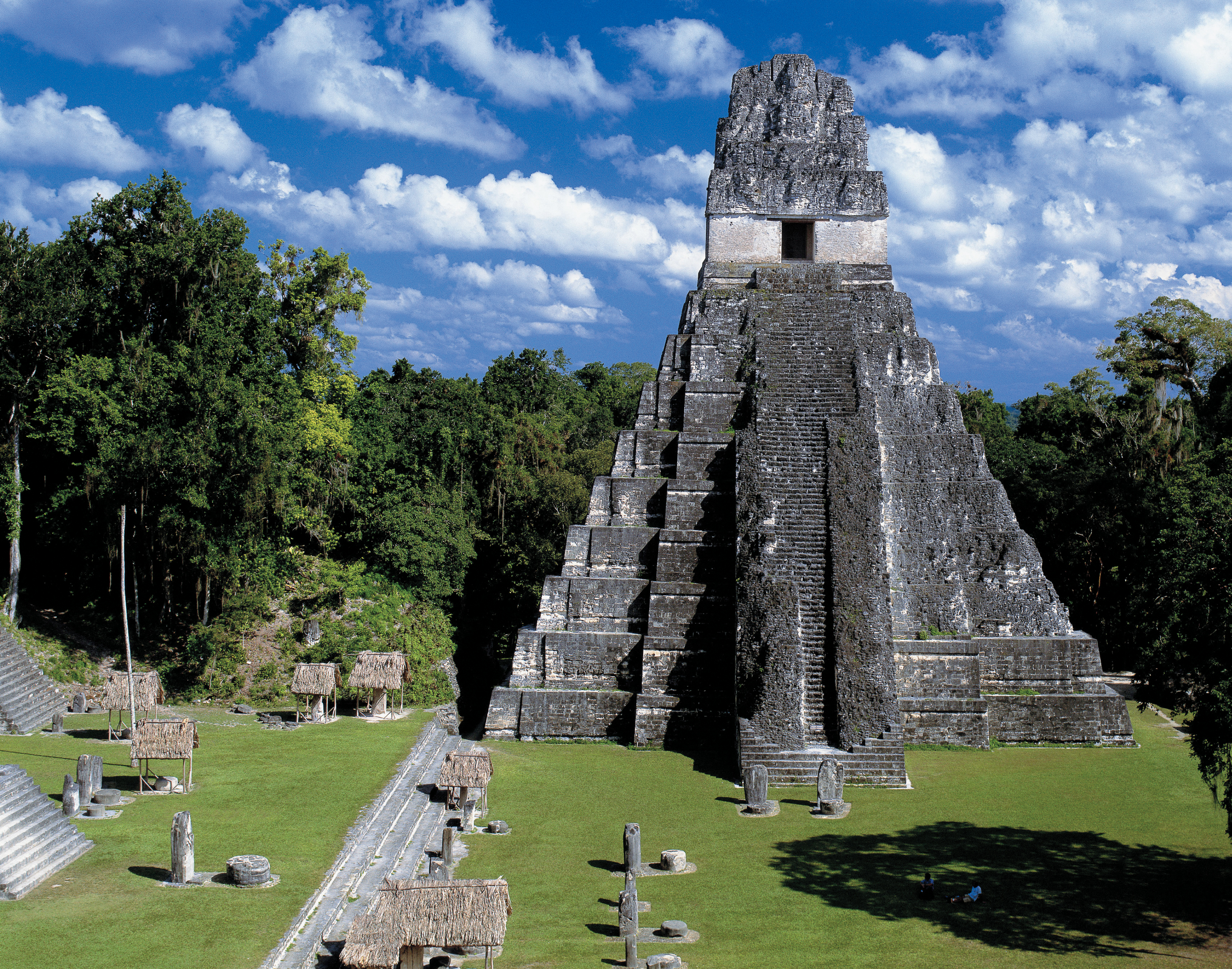
Temple I (Temple of the Giant Jaguar) : 145 ft pyramid, 9 tiers
found in Tikal, Guatemala
Classic Maya Culture
250 CE – 900 CE
Your eBook, Kleiner Art Through the Ages, 15th edition, describes the image as follows. ” Temple I (also called the Temple of the Giant Jaguar after a motif on one of its carved wood lintels), reaches a height of about 145 feet. Considerable evidence indicates that the builders of Tikal, Palenque, and other Maya sites painted the exteriors of their temples red or red, white, and other bright colors. The Temple of the Giant Jaguar at Tikal is the temple-mausoleum of one of the city’s greatest rulers, Hasaw Chan K’awiil, who died in 732 CE. The Maya buried him in a vaulted chamber under the pyramid’s base. The towering (140 foot-high) structure consists of nine sharply inclining platforms—probably a reference to the nine levels of the Underworld (see “ The Underworld, the Sun, and Mesoamerican Pyramid Design â€)—and a three-chambered temple reached by a narrow stairway. Surmounting the temple is an elaborately sculpted roof comb, a vertical architectural projection that once bore the ruler’s gigantic portrait modeled in stucco.”
The Maya, whose cultural region was east of the Valley of Mexico into the highlands and lowlands of Guatemala, Honduras, and Belize, went through several periods of development that have been identified by scholars as preclassic, classic, and post- classic. The 600 years of the Classic Maya culture were dominated by city-states whose rulers who were often at war with one another. Like the earlier cultures of Meso-America, the Maya built large public temple complexes, practiced human sacrifice, the ballgame, and many other features that we have come to know as typical of this region. Most importantly, the Maya developed an extensive, complex system of writing in the form of glyphs that have been translated to reveal a wealth of political and historical information about the Maya rulers and their obsession with legitimacy of rule and performing sacrificial rituals to ensure prosperity and the favor of the gods. The site that came to be known as Tikal in the 19thcentury, after its re-discovery, is one of the oldest and most important of Maya cities.
Form
Stepped pyramid of 9 levels, taller than wide, with extremely steep and high stairways; the top is covered with a square structure topped with what has been called, descriptively, a “roof comb†that once bore the likeness of the ruler modeled in stucco. Royal burials under the pyramid make it a temple-mausoleum, like Angkor Wat. All Maya temples were plastered and painted in bright colors.
Style
The proportions and details are unique to Tikal.
Meaning
Temple-mausoleum in honor of the ruler, Hasaw Chan K’awiil, d. 732.
Context
The collapse of the Maya is another mystery. It may have been a combination of environmental and man-made factors: warfare, climate change, famine, etc.
Taj Mahal
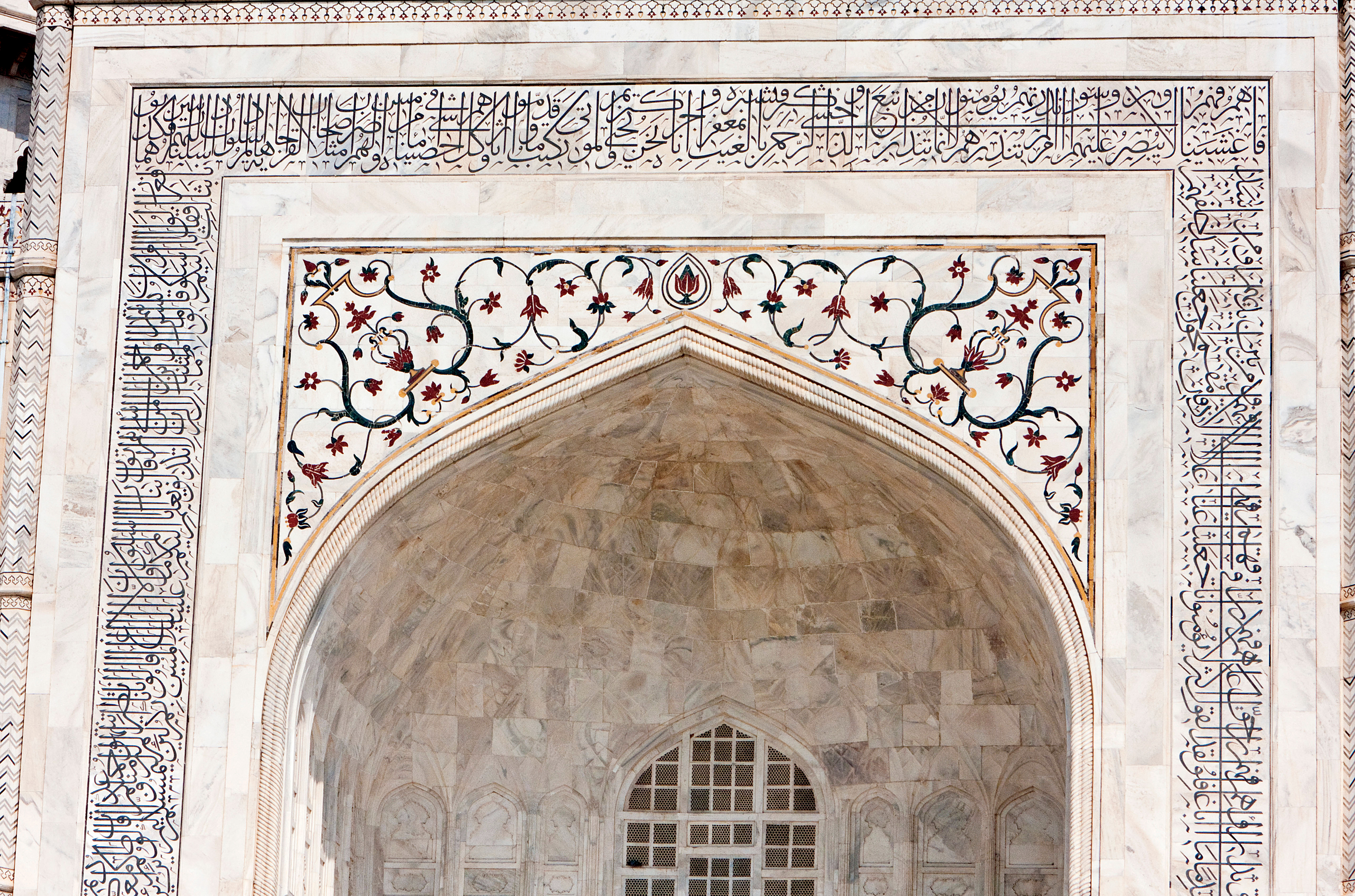
Taj Mahal: Detail of the pietra dura stonework of the area above the central niche of the facade of the Taj Mahal
found in Agra, India
Mughal Empire
1526 CE – 1857 CE
Your eBook, Kleiner Art Through the Ages, 15th edition, describes the image as follows. ” Monumental tombs were not part of either the Hindu or Buddhist traditions but had a long history of Islamic architecture. The Delhi sultans had erected tombs in India, but none could compare in grandeur to the fabled Taj Mahal at Agra. Shah Jahan (r. 1628–1658), Jahangir’s son, built the immense mausoleum as a memorial to his favorite wife, whose official title was Mumtaz Mahal (1593–1631), or “Chosen of the Palace.†Taj Mahal means “Crown Palace,†and the mausoleum eventually became the ruler’s tomb as well. It figures prominently in official histories of Shah Jahan’s reign (see “ Abd al-Hamid Lahori on the Taj Mahal â€). The dome-on-cube shape of the central block has antecedents in earlier Islamic mausoleums and other Islamic buildings, such as the Alai Darvaza at Delhi, but modifications and refinements in the design of the Agra tomb converted the earlier massive structures into an almost weightless vision of glistening white marble. The Agra mausoleum seems to float magically above the broad water channels and tree-lined reflecting pools punctuating the fountain-filled garden leading to it. Reinforcing the illusion of the marble tomb being suspended above water is the absence of any visible means of ascent to the upper platform. A stairway does exist, but the architect intentionally hid it from the view of anyone who approaches the memorial. The Taj Mahal follows the traditional char-bagh (“four-plotâ€) plan of Iranian garden pavilions, which symbolized the Koranic Garden of Paradise. Today, however, the mausoleum appears to stand at the northern end of the garden on the edge of the Yamuna River, rather than in the center of the formal garden, as it should in a charbagh plan. Originally, the gardens extended to the other side of the river, and the Taj Mahal did, in fact, occupy a central position. The tomb itself is octagonal in plan and has typically Iranian arcuated niches on each side. The interplay of shadowy voids with light-reflecting marble walls that seem paper-thin creates an impression of translucency, further enhanced by the pietra dura inlay of precious and semiprecious stones in the stone walls. The pointed arches lead the eye in a sweeping upward movement toward the climactic dome, shaped like a crown (taj). Four carefully related minarets and two flanking triple-domed pavilions enhance and stabilize the soaring form of the mausoleum. The designer—probably Ustad Ahmad Lahori (d. 1649), Shah Jahan’s chief court architect—achieved this delicate balance between verticality and horizontality by strictly applying an all-encompassing system of proportions. The Taj Mahal (excluding the minarets) is as wide as it is tall, and the height of its dome is equal to the height of the facade. The mausoleum is a unique and brilliant fusion of Islamic, Hindu, and Byzantine elements. “
Form
Although it has the appearance of a mosque, it is a mausoleum where the wife of Shah Jehan (Jahan), who died giving birth to her 14th child, is entombed. Shah Jehan’s tomb was eventually placed there as well. The ground plan of the mausoleum is octagonal resting on a square. The proportions are close to 1:1, height equals width.
Style
A beautiful, seamless hybrid of several cultural forms associated with Islam. The building is treated like an inlaid jewel box: the marble surfaces are inlaid with exquisite floral and geometric arabesques (like those at Isfahan) in precious stones of different colors. The long reflecting pool doubles the impact of the building, which changes color in the light. What features of the architecture can you trace back to other Islamic buildings we have seen?
Meaning
Famously, the building is an act of loving devotion by a grieving husband; a monument to love. It is said that the four towers (which resemble minarets) are like poles supporting the blue tent of the sky.
Context
Deemed by all the finest architectural achievement of Mughal India.
At the top of each paper include a digital image and clearly identify the work of art by: Title, artist (if known), date, material, dimensions, and where it is now located.


 Jermaine Byrant
 Nicole Johnson


 OVER
OVER
 RATING
 YEARS
YEARS


